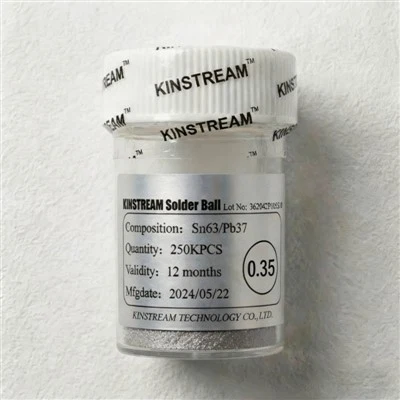

In semiconductor packaging, solder balls, despite their miniature size, perform critical electrical and mechanical interconnection functions. For a new solder ball material, the journey from customer requirement initiation to mass production is far more than a simple "sampling – order placement" workflow. It proceeds through multiple phases: specification confirmation, NPI sampling, material validation, customer process validation, Qualification, supplier approval and mass production ramp-up.
1. Specification: Define Solder Ball Specifications
Once NPI (New Product Introduction) kicks off, the first step is to clarify the customer's specific requirements for solder balls, including alloy system, ball diameter and tolerances, sphericity, surface condition, packaging method and other special requirements. Ball diameter and tolerances are not merely dimensional parameters. Solder balls must be compatible with the customer's pad size, pad pitch and reflow process. Especially for fine-pitch packaging, variations in solder ball dimensions may further impact bump pitch, standoff height and post-reflow solder joint morphology.
At this stage, suppliers shall not only confirm customer specifications but also evaluate internal manufacturing and quality control capabilities to establish a clear specification baseline for subsequent NPI sampling.
2. NPI Sampling: Complete Prototype Development
After specification finalization, the supplier conducts NPI sampling per customer requirements and performs in-house inspection to verify whether prototypes meet specifications. Key inspection items cover:
Alloy composition
Ball diameter and size distribution
Sphericity
Visual appearance and surface condition
Packaging and lot traceability
The core question addressed in this phase: Can qualified and consistent solder ball prototypes be produced to meet customer requirements?
From the supplier's perspective, NPI is not limited to manufacturing a single batch of samples. More importantly, it establishes repeatable manufacturing conditions for future production via these prototypes.
3. Process Validation: Integration into Customer's Actual Process
Once prototypes pass basic material specification validation, they move into the customer's real packaging and assembly workflow for process verification. Solder balls do not function independently; their soldering performance is affected by pad surface finish, flux chemistry and reflow profile. This phase primarily validates the compatibility between solder balls and the customer's manufacturing process. Typical evaluation items include:
Placement performance
Solderability / wetting behavior
Reflow characteristics
Solder joint formation
Solder joint features such as IMC and voids
For fine-pitch packaging, customers care more than just a single successful trial run. They require solder balls to deliver stable performance within the defined process window. The core question addressed here: Can this solder ball be reliably deployed within the customer's actual production process?
4. Qualification: Verify Long-Term Reliability
Depending on the customer's product type, application scenario and quality requirements, the project may advance to the Qualification stage. The evaluation focus shifts from short-term process performance to long-term reliability. Common reliability tests include temperature cycling, thermal shock, high-temperature storage, alongside other mechanical and electrical reliability assessments.
Under sustained thermal cycling and mechanical stress, mismatched coefficients of thermal expansion (CTE) among solder alloy, pads and packaging materials may induce fatigue, cracking and other failure modes in solder joints. Therefore, reliability qualification does not evaluate a standalone solder ball; it assesses the overall solder joint reliability formed by solder ball + pad + solder interface + packaging structure.
5. Supplier Approval: Validate Supplier Competency
After successful material and process validation, customers may proceed with supplier approval. This stage looks beyond the product itself and audits the supplier's:
Quality management system
Manufacturing capability
In-process control
Traceability system
Production capacity
Supply continuity
Change control process
Customers need confirmation not just that "this batch of samples is acceptable", but that the supplier can consistently manufacture products with identical specifications and quality levels over the long term.
6. Mass Production: Enter Stable Volume Manufacturing
Upon completion of validation activities and supplier approval, the project transitions into mass production. During volume manufacturing, suppliers must continuously control critical solder ball parameters including alloy composition, ball diameter, sphericity and surface condition. SPC, Cpk analysis, lot management and in-process controls are deployed to guarantee batch-to-batch consistency. Mass production truly tests the supplier's sustained manufacturing capability: NPI proves "it can be made"; mass production proves "it can be made consistently and reliably over the long run".
The NPI Journey of a Single Solder Ball
To summarize the full lifecycle of a solder ball from NPI to mass production: Specification Confirmation → NPI Sampling → Material Validation → Customer Process Validation → Qualification → Supplier Approval → Stable Mass Production
Each stage solves a distinct problem:
Specification Confirmation defines what is required
NPI Sampling verifies whether it can be manufactured
Material Validation confirms whether the material meets requirements
Process Validation checks whether it can operate stably in production
Qualification assesses long-term reliability under service conditions
Supplier Approval validates sustained supply capability
Mass Production ultimately proves ability for continuous, consistent manufacturing